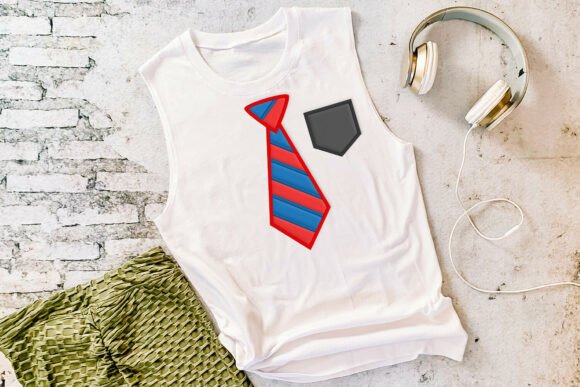
Stripe Tie Pocket Applique Embroidery
A Smart, Scalable Branding Choice for Small Business Merch
As an embroidery designer who’s developed hundreds of commercial designs for cafés, boutiques, florists, pet brands, and handmade studios, my first impression of Stripe Tie Pocket Applique Embroidery is immediate: it’s a confident yet approachable design—classic in structure, playful in execution. The striped necktie motif reads as timeless and professional, while the faux pocket adds subtle dimension and craft-forward charm. It doesn’t scream “corporate”; instead, it whispers “thoughtfully made,” making it ideal for small businesses that want to balance credibility with warmth.
Where This Embroidery File Shines in Real Business Use
This machine embroidery design performs exceptionally well across multiple branded applications—especially when used intentionally. As an embroidered patch, it works beautifully on denim jackets, canvas tote bags, and staff aprons. Its clean silhouette holds up at 2.5”–3.5”, offering strong visual impact without overwhelming the garment. For a local bakery or creative studio, attaching it to the chest of a staff uniform signals cohesion and care—no logo needed, just identity through detail.
In cap embroidery, the smallest size (noted as suitable for newborns or teddy bear clothes) is actually perfect for structured front panels—think flat-bill caps for baristas or floral designers. The appliqué construction reduces stitch density compared to full-fill satin-stitch alternatives, which means less bulk, better breathability, and faster hooping. On tote bags or reusable market sacks, the design reads clearly even from a distance, reinforcing brand recognition without relying on text.
For custom apparel like linen aprons or cotton work shirts, Stripe Tie Pocket Applique Embroidery adds personality to otherwise utilitarian items—elevating perceived value while staying rooted in craftsmanship. Etsy sellers and handmade product brands can use it as a subtle signature accent on packaging tags, fabric labels, or even as a sewn-on embellishment on gift boxes. It also translates well into a printable mockup for client presentations, helping boutique owners visualize how their brand assets will appear across touchpoints.
Smart Placement & Practical Limits
Like any thoughtful digital embroidery file, this design has sweet spots—and boundaries. Avoid placing it on highly curved surfaces (like deep cap crowns or tightly fitted sleeves) without testing first. The faux pocket detail relies on crisp edge definition, so dense knit fabrics or heavy terry cloth may obscure its nuance. Also, while the smallest size is charming on infantwear, it’s *too* delicate for high-traffic areas like pocket flaps on workwear—thread breakage or fraying becomes more likely after repeated washing.
On dark uniforms, contrast matters: test your thread colors carefully. A navy tie with white pocket stitching reads cleanly, but charcoal grey with light grey thread may fade visually. Likewise, avoid pairing it with ultra-fine lettering or tiny brand names directly beside it—the composition isn’t built for tight typographic integration. If your brand relies heavily on monogramming or taglines, use Stripe Tie Pocket Applique Embroidery as a standalone accent—not a hybrid element.
How It Strengthens Your Brand Identity
Small business owners often underestimate how much visual consistency builds trust. When customers see the same refined, tactile detail across your aprons, tote bags, and staff caps, they subconsciously register professionalism—even if they can’t name why. Stripe Tie Pocket Applique Embroidery supports that perception: it feels intentional, not generic. Unlike clipart-style motifs, its appliqué construction implies attention to materiality and technique—aligning perfectly with values-driven brands (think zero-waste shops, artisanal bakeries, or slow-fashion labels).
It also enhances buyer engagement. Customers don’t just buy a tote bag—they remember the clever tie detail, snap a photo, and share it. That organic visibility is gold for small-scale marketing. And because it avoids clichés (no coffee cups, no paw prints), it stays versatile across seasons and product lines—making it a long-term design asset, not a trend-dependent flash-in-the-pan.
What Every Embroidery Designer Checks Before Production
Before committing to bulk runs for your small business merch, run these checks:
- Test it in black and white first—to confirm outline clarity and balance without color distraction
- Verify performance at your target patch size—especially if using under 2.75” for cap fronts or sleeve accents
- Review thread color contrast on your actual fabric swatches—not just screen previews
- Inspect spacing between stripe elements and pocket edges—tight gaps can fill in during stitching
- Confirm hoop size compatibility with your machine and intended placement (e.g., cap frames vs. flat hoops)
- Test on real fabric with your chosen stabilizer—appliqué behaves differently on twill vs. canvas vs. lightweight cotton
- Create a physical mockup before client approval—stitch quality, texture, and drape change everything
- Compare it beside your other design assets—does it harmonize with your logo, typography, and overall palette?
- Confirm commercial licensing before using it on products for resale—this is non-negotiable for commercial embroidery
Remember: the description notes “8 formats, 5 sizes included”—so leverage that flexibility. Use the largest size for tote bag centerpieces, mid-sizes for apron corners, and the smallest for subtle cap accents or product packaging. But always cross-check those size claims against your own production specs—don’t assume “smallest size” matches your minimum viable patch dimension.
Final Thought: A Versatile Anchor for Handmade Product Brands
Stripe Tie Pocket Applique Embroidery isn’t just another embroidery file. It’s a ready-made expression of craft, confidence, and quiet sophistication—ideal for businesses that sell experience as much as product. Whether you’re embroidering staff uniforms for a neighborhood florist or adding bespoke flair to limited-run tote bags for a ceramic studio, this design delivers consistent, scalable impact. Just pair it with smart execution—and let the details do the talking.