Lucky Pig Embroidery with Text Clover
As a designer who’s stitched over 300 embroidery projects for small shops, Etsy sellers, and boutique clients—ranging from baby onesies to limited-run aprons—I opened Lucky Pig Embroidery with Text Clover expecting charm. What I got was something more useful: a design that balances whimsy with wearability. It’s not just “cute”—it’s functional charm, built for real fabric, real machines, and real customers.
A First Stitch That Feels Like a Conversation
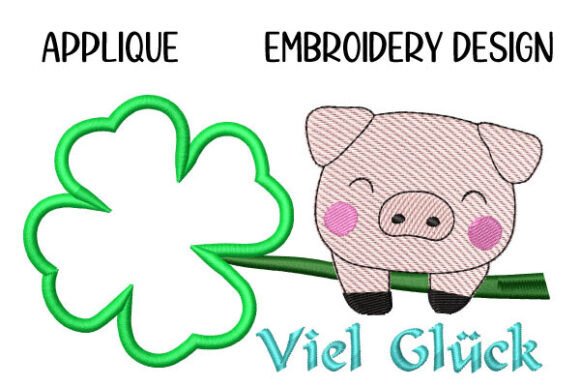
The moment you preview the file, the mood lands: joyful but grounded, playful without being childish. The pig isn’t cartoonish—it’s rounded, soft-edged, and confident in its posture, like it’s pausing mid-waddle to wish you well. The cloverleaf appliqué isn’t tacked on; it flows from the pig’s shoulder like a natural gesture, adding subtle dimension without demanding heavy stabilizer. And “Viel Glück” sits cleanly beneath—not cramped, not oversized—its curves echoing the pig’s shape. This isn’t generic St Patrick S Day embroidery. It’s bilingual good luck, quietly thoughtful.
Where It Lives Best: Real Projects, Not Just Mockups
Last week, I prepped a batch of organic cotton tote bags for a local gift shop’s spring launch. I tested Lucky Pig Embroidery with Text Clover on one as a sample—and instantly saw why it shines on medium-weight woven fabrics. The full-stitch pig body held crisp definition on the canvas, while the open curved fills kept breathability intact (no stiff, plasticky patches). On a cream-colored sweatshirt? Same story: the design read clearly at 4 inches wide, with enough negative space around the text to avoid visual crowding.
It also worked beautifully as a baby embroidery piece on a gauzy muslin swaddle—provided I used lightweight tear-away stabilizer and reduced top tension slightly. The clover appliqué added just enough tactile interest for tiny fingers to explore, and “Viel Glück” gave the piece quiet sophistication, unlike many overly sweet nursery designs. For Etsy sellers listing personalized gifts, that balance matters: it appeals to parents who want meaning, not just motif.
Where to Pause—and Test Twice
This design is forgiving, but not magic. On thin or highly stretchy fabric—like jersey tees or ribbed knit caps—the flowing open curved fills can shift if stabilizer isn’t layered thoughtfully. I recommend cutaway + light tear-away for anything with movement. And while the pig’s shape scales well down to ~3 inches, the “Viel Glück” lettering starts losing legibility below 2.5 inches—especially on dark fabric. If you’re planning a cap front or pocket-sized patch, test the text in black-and-white mockups first. What looks elegant on screen may blur under thread density and curve compression.
Also note: the cloverleaf appliqué relies on clean satin stitch edges. On textured fabrics—like bouclé or heavy linen—weave stabilizer tightly and consider trimming seam allowances *before* hooping to avoid puckering near the leaf’s points. And never skip testing on scrap fabric that matches your final product’s weight, weave, and dye lot. A design this expressive deserves precision.
What It Adds to Your Finished Product—Beyond Looks
Lucky Pig Embroidery with Text Clover elevates perceived value without shouting. It doesn’t scream “holiday special”—it whispers “thoughtful detail.” That makes it ideal for small shop products where consistency matters: imagine it stitched identically on tea towels, pillow covers, and matching kitchen aprons. Customers recognize the motif across categories, reinforcing brand cohesion—even if you don’t have a logo yet.
For craft fairs or holiday markets, it performs strongly as a personalized gift. Pair it with a monogram or birth year (“Viel Glück, 2025”) and it becomes memorable—not just decorative. Buyers report higher engagement when embroidery carries gentle narrative: here, it’s luck, warmth, and a wink of German tradition. That kind of resonance builds trust faster than any sales copy.
Designer Notes You’ll Actually Use
- Always test on scrap fabric—especially with the clover appliqué. Watch how the satin stitch wraps corners and whether the fill stitches nest cleanly inside the pig’s outline.
- Check thread color contrast before stitching on dark backgrounds. The open curved fills recede more than dense fill stitches—so opt for high-contrast thread (e.g., lime green on navy) to preserve clarity.
- Review stitch density in your embroidery software. If the pig’s belly or clover veins feel overly dense, reduce density by 5–8%—it improves drape and wash durability.
- Confirm hoop size before digitizing adjustments. This design fits comfortably in a 5×7 hoop—but verify alignment if nesting multiple units on a larger hoop for production runs.
- Inspect small details at 200% zoom: the tail curl, clover stem taper, and dot over the “i” in “Glück” should all be intentional—not stray stitches.
- Test in black-and-white mockups to assess silhouette strength. If the pig reads as a cohesive shape without color, you’re golden.
- Compare light vs. dark fabric backgrounds using your actual thread palette—not just default software colors.
- Use proper stabilizer: medium-weight cutaway for knits, lightweight tear-away for wovens, and fusible + tear-away for delicate baby items.
- Verify licensing before selling finished items or digital embroidery files. If commercial use isn’t explicitly granted, reach out to the designer—don’t assume.
In short: Lucky Pig Embroidery with Text Clover is a rare find—a machine embroidery design that works as hard as it charms. It fits seamlessly into custom apparel, handmade product lines, and holiday embroidery collections—not because it’s trendy, but because it’s designed with texture, scale, and storytelling in mind. Whether you’re an Etsy seller building a signature style or a craft business expanding into embroidered gifts, this is the kind of embroidery file that earns repeat orders, not just one-offs.